How Do Migraines & Headaches Differ & When to See a Doctor
Center : Neurology Center
Article by : Dr. Pramote Onudom

- A headache is a symptom; a migraine is a neurological condition that includes headache as one of its features.
- Common types of headache include tension, cluster, sinus, and medication overuse headaches.
- Types of migraines include migraine without aura, with aura, chronic migraine, hemiplegic migraine, and vestibular migraine.
- Status migrainosus, a migraine lasting more than 72 hours despite treatment, is generally considered the most severe form.
- Treating early, resting in a dark room, hydration, and prescribed migraine medication offer the most reliable relief.
- Frequent, worsening, or sudden severe headaches need a neurology evaluation or emergency care.
Although commonly used interchangeably, “headache” and “migraine” refer to distinct conditions. Their responses to treatments differ, and what appears to be a bad headache might actually indicate a need for medical intervention
If you’ve been feeling a throbbing ache, sorting out the migraine vs headache question is the first step to getting the right relief.
Table of Contents
- What Is the Difference Between a Migraine and a Headache?
- Types of Headache: The Main Categories
- Types of Migraines You Should Know
- How to Tell If You Have a Migraine or Just a Headache
- How to Make a Migraine Go Away
- When Should You See a Doctor About Head Pain?
- Get Headache and Migraine Care at Nakornthon Neurology Center
- Frequently Asked Questions About Migraine vs Headache
- Free Online Consultation with a Specialist
What Is the Difference Between a Migraine and a Headache?
A headache is a symptom, pain or pressure in the head, scalp, or neck, that can have many causes. In contrast, a migraine is a neurological condition that produces a headache as one of its features, along with a broader set of symptoms.
Headaches are mainly just pain, but migraines are complex neurological events affecting the entire body, often with symptoms like visual issues, nausea, and extreme sensitivity before the pain even starts. Standard pain relievers usually help headaches, but migraines are different, leading to insufficient relief when treated as tension headaches.
Types of Headache: The Main Categories
Several types of headache show up in clinical practice:
- Tension headache: The most common type. A dull, steady pressure like a tight band around the skull. Usually bilateral and mild to moderate, triggered by stress, posture, eye strain, or dehydration.
- Cluster headache: Intense, piercing pain around one eye, in clusters over days or weeks. Attacks last 15 minutes to 3 hours, often with a red or watering eye, drooping eyelid, and nasal congestion on the same side. This is more common in men.
- Sinus headache: Pain and pressure around the forehead, cheekbones, and nose with sinus congestion. Many "sinus headaches" are actually migraines with facial pressure.
- Medication overuse headache: A rebound headache from taking pain relief too often. Medication used more than 10 to 15 days per month risks chronic daily headache.
Types of Migraines You Should Know
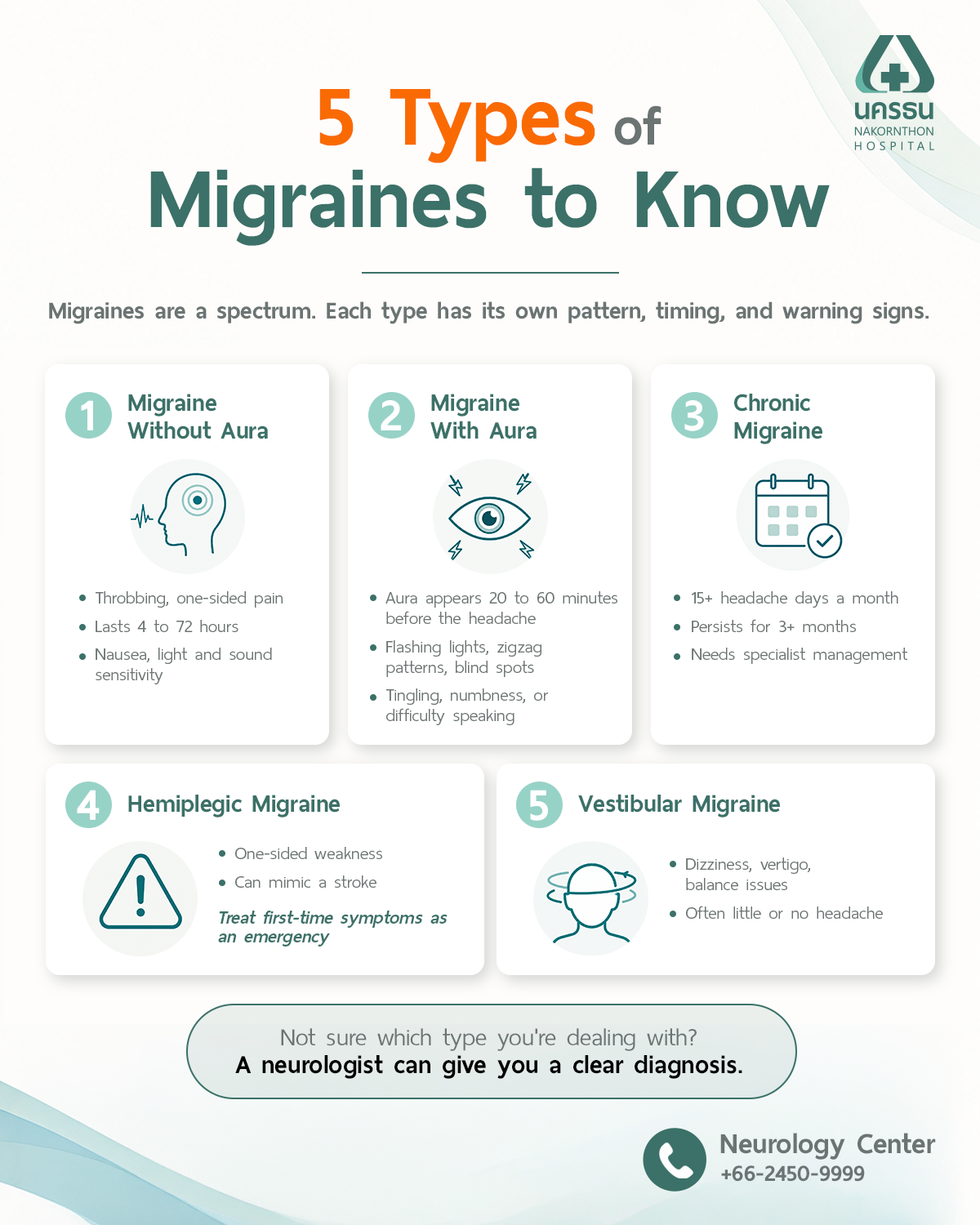
Besides headaches, there are several main types of migraines, which include:
- Migraine without aura: The most common form. Moderate to severe throbbing pain, usually one-sided, lasting 4 to 72 hours, with nausea, vomiting, and light (photophobia) and sound (phonophobia) sensitivity. Physical activity makes it worse.
- Migraine with aura: Neurological symptoms appear 20 to 60 minutes before the headache. Aura usually affects vision (flashing lights, zigzag patterns, blind spots) and can include tingling, numbness, or difficulty speaking.
- Chronic migraine: 15 or more headache days per month for over three months, with at least eight meeting migraine criteria. Needs specialist management with preventive medications, CGRP injections, or Transcranial Magnetic Stimulation (TMS).
- Hemiplegic migraine: A rare but serious type where the aura includes temporary one-sided motor weakness. Symptoms can resemble a stroke (facial drooping, arm weakness, speech difficulty), so first-time symptoms need emergency assessment.
- Vestibular migraine: Episodes of dizziness, vertigo, and balance problems, sometimes with minimal head pain. Often misdiagnosed as an inner ear problem.
What's the Worst Type of Migraine?
Status migrainosus, defined as a migraine attack that persists for over 72 hours even with treatment, is typically regarded as the most severe form. This can lead to severe dehydration and exhaustion, potentially requiring hospitalization and IV fluids.
Similarly, hemiplegic migraine is viewed as exceptionally severe due to its neurological symptoms potentially being confused with stroke.

How to Tell If You Have a Migraine or Just a Headache

The aching sensations might seem similar, but there are nuances. If the pain is a dull, steady pressure on both sides, mild enough for you to continue daily activities, with little sensitivity to light or sound, and resolves in a few hours with rest or pain relief, it's likely a tension headache.
If the pain is of moderate to severe intensity, throbbing, usually unilateral, exacerbated by physical exertion, accompanied by nausea or vomiting, heightened sensitivity to light, sound, or odors, and potentially preceded by visual anomalies or paresthesia, it is likely a migraine.
Note: These are guidelines, not a diagnostic tool. Persistent, frequent, or changing head pain warrants a medical evaluation regardless of type.How to Make a Migraine Go Away
No single answer works for every migraine, but a few approaches have consistent evidence.
- Take pain relief or prescribed migraine medication at the first sign of an attack, since waiting until pain is severe sharply reduces effectiveness.
- Move to a dark, quiet room, apply a cold compress, and stay hydrated.
- Prescribed treatments include triptans (the first-line acute medication), CGRP inhibitors (for preventive injections and acute treatment), and anti-nausea medication.
If migraines occur more than four days per month or disrupt daily life, preventive options, including daily medications, CGRP injections, and TMS, are worth discussing with a nerve specialist. Consistent sleep, regular meals, hydration, stress management, and a headache diary also reduce frequency.
When Should You See a Doctor About Head Pain?
See a nerve specialist if you have headaches more than 15 days per month, they're getting more frequent or severe, over-the-counter medication isn't working, migraines are disrupting daily life, or you've never had a formal evaluation.
However, seek emergency care immediately if you experience any of the following:
- Sudden, extremely severe headache ("the worst headache of my life," can signal a possible brain aneurysm rupture)
- Headache with fever, stiff neck, and light sensitivity (possible meningitis)
- Headache with facial drooping, arm weakness, or slurred speech (possible stroke
- Headache after a head injury
- A new headache after age 50
- A headache that wakes you from sleep and worsens
Severe conditions like these warrant immediate medical attention by professionals.
Get Headache and Migraine Care at Nakornthon Neurology Center
If your headaches recur, intensify, or no longer improve with usual treatments, it’s time to seek a professional diagnosis instead of self-treating. Effective treatments for most chronic migraines exist, but they require a specialist’s diagnosis of the specific type.
At Nakornthon Neurology Center, we diagnose and treat the full range of headache and migraine conditions. MRI is available when imaging is needed to rule out structural causes, and CGRP injections and Transcranial Magnetic Stimulation (TMS) offer specialist-administered options for chronic and treatment-resistant cases. Our specialists have dedicated expertise in headache disorders, and our English-speaking team is here to support you if you’re an expatriate or international patient.
If migraines are affecting your quality of life and you've been managing them on your own, a single consultation with our Neurology Center can change the entire approach. Make an appointment with us today.
Contact & Appointments - Neurology Center
- Facebook Fanpage: Nakornthon Hospital - International Patient
- LINE Official: @nakornthoninter
- Open: Daily, Monday to Sunday, 8:00 AM to 8:00 PM
- Tel: 02-450-9999 1050-1051
Frequently Asked Questions About Migraine vs Headache
-
Q: What's the worst type of migraine?
A: Status migrainosus, a migraine that lasts longer than 72 hours despite treatment, is generally considered the most severe form. It can cause dehydration from vomiting, extreme exhaustion, and may require hospital-level care, including IV fluids and medication. Hemiplegic migraine is also considered particularly serious because its symptoms can closely resemble a stroke.
-
Q: How do I make a migraine go away quickly?
A: Take pain relief or prescribed migraine medication as early as possible, since effectiveness drops sharply once pain is severe. Move to a dark, quiet room, apply a cold compress to the forehead or neck, and stay hydrated. For frequent migraines, prescription options like triptans, CGRP inhibitors, and anti-nausea medication offer more reliable relief and are best discussed with a neurologist.
-
Q: How do I know if I have a migraine or just a headache?
A: You likely have a tension headache if the pain is a dull, steady pressure on both sides, mild enough that you can keep going with daily activities, and with little to no sensitivity to light or sound. You likely have a migraine if the pain is throbbing, often one-sided, worsens with movement, is accompanied by nausea or vomiting, is highly sensitive to light, sound, or smells, and is possibly preceded by aura symptoms like flashing lights or tingling.
-
Q: When should I see a doctor about my headaches?
A: See a neurologist if you have headaches more than 15 days per month, your headaches are getting more frequent or severe, over-the-counter medication is no longer working, or migraines are disrupting daily life. Seek emergency care immediately for a sudden, severe headache, headache with fever and stiff neck, or headache with facial drooping, arm weakness, or slurred speech.

Free Online Consultation
Article of Neurology Center